View the I-Frame vs. S-Frame Roundtable Discussion
Watch the roundtable discussion on the i-frame vs. s-frame debate, share your perspective, and five questions to consider.


Watch the roundtable discussion on the i-frame vs. s-frame debate, share your perspective, and five questions to consider.

Applied behavioral scientists believe their work can influence people’s lives for the better. But what is the most effective way to make that happen?

On the heels of WWII, a team of psychologists set out to solve global conflict. Their lab? Boys summer camps. Their goal? Set the 11- and 12-year-old boys against one another to discover what, if anything, could restore peace. The result? One of psychology’s most enduring and controversial experiments.

For your intellectual travels this summer, a baker’s dozen of behavioral science books newly published this year.

The W.E.I.R.D research participant problem persists not because scientists fail to see it as a problem worth solving, but because conducting studies in new, unfamiliar places is difficult. But overcoming this difficulty is doable and essential.

Approximately 2 billion people live in conflict-affected areas. Yet most of the theories, experiments, and interventions developed in behavioral science are based on stable contexts. It’s time to stop treating conflict as an edge case.
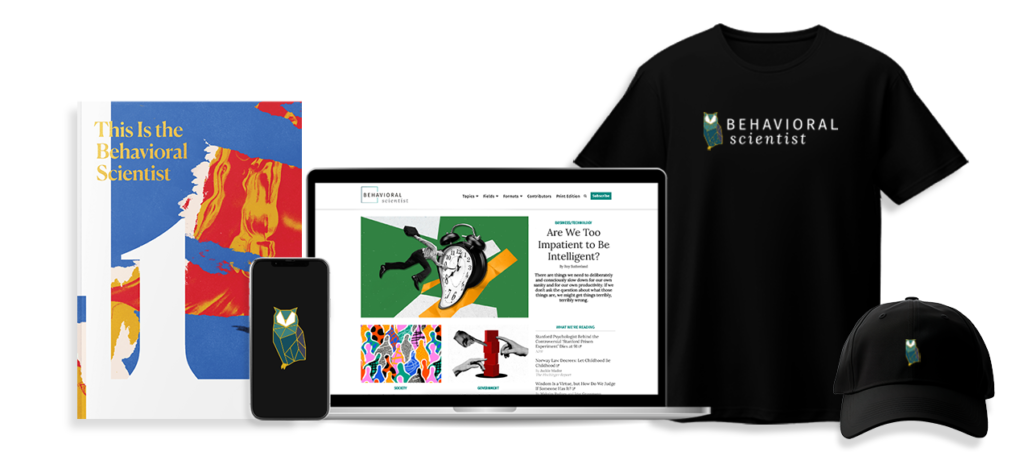
Become a Subscriber — Special offer: Receive a copy of the award-winning print edition, Brain Meets World, or a Behavioral Scientist t-shirt or hat when you join at the Print + Digital + Events or Investor level.