
For your intellectual travels this summer, we’ve curated a baker’s dozen of behavioral science books newly published this year. Explore the mysteries of life and consciousness, glimpse the power of constraints and the games that define our lives, navigate life’s cliffs, and find the places that will make you who you are.
— Heather Graci, Editor and Evan Nesterak, Editor-in-Chief
Exploring life, death, and consciousness
“Life begins, with a spark of sentience catalyzed by chemistry and chance, and then it ends, with death,” writes Maria Popova. “The great mystery is not the fable of what lies beyond. The great mystery is what we make of the wilderness between the bookends…”
These two books are a foray into that wilderness. Popova weaves together the tales of people who have attempted to answer questions of life, death, and personhood the best way they knew how—some by discovering the structure of penicillin or tracing the path of Venus, others by writing poetry, and still others by sailing across the ocean.
Michael Pollan confronts the “improbable fact—the miracle!—that in this universe of rock and fire and ice and infinite space, we are somehow not only here but aware.” How are we conscious? Why are we conscious? And where else does consciousness exist?
Popova and Pollan will make you feel at once bigger and smaller—bigger for having grappled with questions that have endured for millenia, and smaller for realizing the limits of what we might ever hope to answer.

Traversal
By Maria Popova
From the back cover: “What is life? What is death? What makes a body a person? What makes a planet a world? In Traversal, Maria Popova illuminates our various instruments of reckoning with the bewilderment of being alive—our telescopes and our treatises, our postulates and our poems—through the intertwined lives, loves, and legacies of visionaries both celebrated and sidelined by history, people born into the margins of their time and place who lived to write the future.”

A World Appears: A Journey Into Consciousness
By Michael Pollan
From the back cover: “When it comes to the phenomenon that is consciousness, there is one point on which scientists, philosophers, and artists all agree: that it feels like something to be us. Yet the fact we have subjective experience of the world remains one of nature’s greatest mysteries. How is it that our mental operations are accompanied by feelings, thoughts, and a sense of self? What would a scientific investigation of our inner life look like, considering we have as little distance and perspective on it as fish do of the sea?”
* * *
A journalist, a philosopher, and a cognitive scientist think about thinking
What makes some constraints stifling and others catalysts for discovery? Why is scoring points energizing in games but soul-deadening in life and work? Where can we use math to model human intelligence, and where does it fall short?
Three new books offer a chance to think deeper about your own thinking. Journalist David Epstein reveals how constraints can propel our thinking. Philosopher C. Thi Nguyen uncovers the games that exist beneath the surface of society; games you’re playing whether you know it or not. Cognitive scientist Tom Griffiths explains how understanding the aspects of human thinking that are likely to remain elusive to AI can change the way we see ourselves and help us appreciate the cognitive mysteries that set us apart.

Inside the Box: How Constraints Make Us Better
By David Epstein
From the back cover: “We live in a world that gives us seemingly infinite choices and prizes freedom above all else. We have an unprecedented number of options regarding what to do, who to be, and how to spend our time. All that choice is wonderful; it is also overwhelming. The irony is that total freedom can be paralyzing, and unlimited resources don’t necessarily lead to the biggest breakthroughs. In fact, overvaluing complete freedom can be disastrous for everything from starting a company to harnessing creativity to finding personal satisfaction. David Epstein argues that all of us—individuals, businesses, institutions, even societies—can benefit from narrowing our options.”

The Score: How to Stop Playing Somebody Else’s Game
By C. Thi Nguyen
From the back cover: “Games are the most important art form of our era. They embody the spirit of free play. They show us the subtle beauty of action everywhere in life in video games, sports, and boardgames—but also cooking, gardening, fly-fishing, and running. They remind us that it isn’t always about outcomes, but about how glorious it feels to be doing the thing. And the scoring systems help get us there, by giving us new goals to try on. Scoring systems are also at the center of our corporations and bureaucracies—in the form of metrics and rankings. They tell us exactly how to measure our success. They encourage us to outsource our values to an external authority. And they push on us to value simple, countable things. Metrics don’t capture what really matters; they only capture what’s easy to measure. The price of that clarity is our independence.”

The Laws of Thought: The Quest for a Mathematical Theory of the Mind
By Tom Griffiths
From the back cover: “Everyone has a basic understanding of how the physical world works. We learn about physics and chemistry in school, letting us explain the world around us in terms of concepts like force, acceleration, and gravity—the Laws of Nature. But we don’t have the same fluency with concepts needed to understand the world inside us—the Laws of Thought. While the story of how mathematics has been used to reveal the mysteries of the universe is familiar, the story of how it has been used to study the mind is not.”
* * *
Bringing data to a gunfight
Economists Alvin Roth and Jennifer Doleac share the conviction that using a data-driven approach to answer moral questions is itself a matter of morality.
In Moral Economics, Nobel-winner Roth shows how conceptualizing divisive social issues like drugs, abortion, and organ donation as markets can expose new ways to make progress in contexts where both sides refuse to compromise. And in The Science of Second Chances, Jennifer Doleac illuminates how many criminal justice policies—no matter how well-meaning—are far from just. But she also shows that where our intuition fails, science can succeed in helping us build a system that leaves everyone better off.
In Doleac’s words: “I see a lack of rigor as unethical. Policies that don’t work don’t help people. If we are serious about improving lives, we need to test our policies carefully to ensure they’re effective.”

Moral Economics: From Prostitution to Organ Sales, What Controversial Transactions Reveal About How Markets Work
By Alvin E. Roth
From the back cover: “Some of the most intractable controversies in our divided society are, at bottom, about what actions and transactions should be banned. . . . Disagreements are fierce because arguments on both sides are often made in uncompromising moral or religious terms. But in Moral Economics, Nobel Prize–winning economist Alvin E. Roth asserts that we can make progress on these and other difficult topics if we view them as markets—tools to help decide who gets what—and understand how those markets can be fine-tuned to be more functional. Markets don’t have to allow everything or ban everything. Prudent market design can find a balance between preserving people’s rights to pursue their own interests and protecting the most vulnerable from harm.”

The Science of Second Chances: A Revolution in Criminal Justice
By Jennifer Doleac
From the back cover: “When criminal justice expert Jennifer Doleac thinks about reform, she’s not just hopeful, she’s optimistic that second chances are possible—for the justice-involved population and the system as a whole. In The Science of Second Chances, she reveals her powerful approach to reducing crime and incarceration. Drawing on cutting-edge economic research and real-world experiments, the book presents a blueprint for reform that runs all the way through the system . . . From DNA databases that increase the likelihood of catching reoffenders to leniency programs for first-time defendants, she reveals a series of surprising interventions that actually work, along with cautionary tales about great ideas that never panned out.”
Read an excerpt from The Science of Second Chances in Behavioral Scientist: “It’s as if they’re standing at a fork in the road, considering what to do next. One direction leads toward more criminal behavior and criminal justice involvement, and the other leads toward a productive, law-abiding life. It turns out that many first-time defendants will choose the better path if we simply get out of their way.”

Three social psychologists on being social
The season of barbecues and beach vacations is upon us. That means spending more time with people—some you might know and love, some you might not know and love yet, and some, well, let’s just say it’s complicated.
Three social psychologists offer insights into our relationships with others. Nicholas Epley illuminates why fundamentally social creatures like us so often choose to keep to ourselves and offers advice for how to overcome the misplaced pessimism that keeps us from saying, “Hello.” Gillian Sandstrom recounts the science behind talking to strangers and shares how her own life grew brighter and richer when she did. And finally, Julia Minson confronts one of the scenarios that keep many of us away from others—disagreement—and shows why we don’t need to feel so daunted by the possibility that we might not see eye to eye with someone.

A Little More Social: How Small Choices Create Unexpected Happiness, Health, and Connection
By Nicholas Epley
From the back cover: “There is a paradox at the core of human life. We are a highly social species uniquely equipped to connect with other people and doing so is better for us. Yet we so often choose to be unsocial. We avoid talking to the stranger who sits next to us. We struggle to move beyond small talk with an acquaintance. We are reluctant to express our gratitude to people we appreciate. Every day, we avoid opportunities to connect with strangers, neighbors, colleagues, friends, and family. By missing those moments, we miss out on all the benefits of a more social life—one that is happier and healthier for everyone.”

Once Upon a Stranger: The Science of How “Small” Talk Can Add Up to a Big Life
By Gillian Sandstrom
From the back cover: “Dr. Gillian Sandstrom reveals that by talking to strangers, we can unlock more joy, curiosity, and goodwill every day. In an age when loneliness is a social health crisis and harmful behaviors like groupthink increase our perception of distance and polarization, this transformational guide explains the benefits of stretching our perceived limits and connecting with our fellow humans.”

How to Disagree Better
By Julia Minson
From the back cover: “We are in a disagreement crisis. The average person would rather go to the dentist than have a twenty-minute conversation with someone that they strongly disagree with. Yet disagreement is both inevitable and essential for everything from navigating decisions at home to running innovative and agile companies to governing democratic societies.”
* * *
The places that make you who you are
Summer is a time when we’re on the move—to places we’ve never been and to places we’ve been again and again. Engineer and behavioral scientist Leidy Klotz asks: How do places shape us? And how can we shape the places that shape us?

In a Good Place: How the Spaces Where We Live, Work, and Play Can Help Us Thrive
By Leidy Klotz
From the back cover: “So many books address how to live a good life. This one is about where. Immersing readers in locations from beach huts to modern office layouts, from the backyard where we once played to the college dorm where we forged lifelong bonds, behavioral scientist Leidy Klotz illuminates how our physical environment determines our habits, our relationships, and even who we are.”
* * *
Navigating life’s cliffs
How should we understand the experiences that change the trajectory of our lives—the end of a career, an unthinkable diagnosis, love found, or love lost? Who are we before these great upheavals, and who do we become afterward?
Author Jim Collins calls these experiences “cliffs,” which require people to “reconstitute their lives and reenvision the years to come.” He spent 10 years identifying pairs of people throughout history who faced similar cliffs and considering how their paths diverged, or didn’t, in their aftermath.
Cognitive scientist Maya Shankar explores change in a different way. After years of conversations with people who have confronted a major change in their life, she brings together their stories to show how people rebuild their lives on “the other side of change.”
“The odds any of us will complete a life without cliffs are close to zero. Some cliffs are bigger than others, but life is punctuated by cliffs,” writes Collins. “Cliffs are us.”

What to Make of a Life: Cliffs, Fog, Fire and the Self-Knowledge Imperative
By Jim Collins
From the back cover: “Two rock musicians confronting a future without the group that had brought them success. Two public figures tainted by scandal having to make decisions about how to rebuild their lives. Two suffragists achieving their epic goal and so left with the puzzle of what to do next. Two figure skaters seeking new purpose when their Olympic careers come to an end. What emerges from Collins’s extensive studies—of writers, actors, scientists, leaders and many others—is a framework for understanding how individual lives can be built, sustained and constantly renewed.”

The Other Side of Change: Who We Become When Life Makes Other Plans
By Maya Shankar
From the back cover: “Shankar invites us to rethink our relationship with change altogether. When a big change happens to us, it can lead to profound change within us. The unique stresses and demands of being thrust into a new reality can lead us to uncover new abilities, perspectives, and values, transforming us in extraordinary ways. What if we saw moments of upheaval as an opportunity to reimagine who we can be, rather than as something to just endure?”
* * *
And four books to keep an eye out for this fall

Agency: The Psychological History of Human Progress (September 8)
By Martin Seligman
From the back cover: “What actually drives human progress? Ecologists point to geography and climate. Sociologists invoke wars and class. Economists follow the money. But none of these accounts explains why innovation and human thriving occurs in some eras and stalls in others—often under identical material conditions. The missing variable, Seligman argues, is the psychological state known as: agency. . . Drawing on six decades of pioneering research and a sweeping reexamination of the last twenty-five hundred years . . . Seligman reveals how surges and declines in agency have quietly steered the course of history.”

Artificial Intimacy: Who We Become When We Talk to Machines
(September 29)
By Sherry Turkle
From the back cover: “Artificial Intimacy is unique in how it traces our new habit of talking to machines through the lifecycle—from children’s earliest attachments to how we face death. But technology, by offering to do everything, teaches us that we neither need nor have the capacity to take risks, have hard conversations, struggle through uncertainty or insecurity, or rely on our own faculties and judgment. Turkle has spent decades studying how digital technologies isolate us from one another. Now, in her long-awaited follow-up to Reclaiming Conversation, she offers both a cautionary tale and a roadmap for reclaiming our humanity in the age of AI.”

Profits, Prophets, Coaches and Kings: (When) Do Leaders Matter?
(September 1)
By Jared Diamond
From the back cover: “We often read history as the biographies of ‘great men’ who shaped the world. But are leaders, whichever field they are in, really that influential? . . . Historian and bestselling author Jared Diamond argues that leaders are neither heroic exceptions nor products of circumstance. Looking at four different spheres: history, business, sport, and religion, Diamond asks under which conditions is a leader most likely to make a difference and why.”
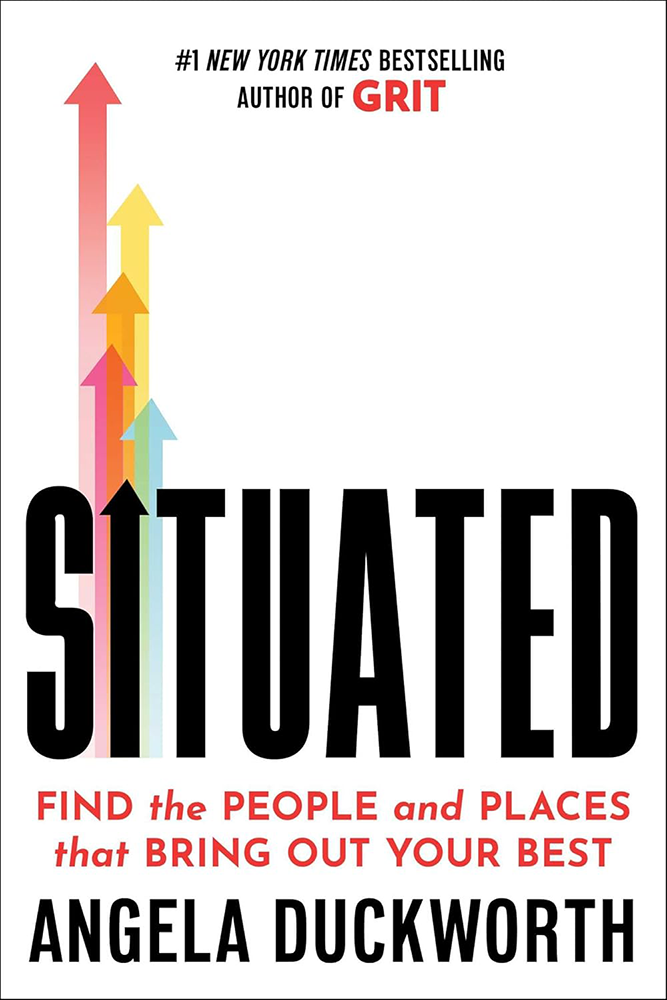
Situated: Find the People and Places That Bring Out Your Best (September 1)
By Angela Duckworth
From the back cover: “How you situate yourself to meet a challenge can be crucial. Duckworth’s in-depth research reveals the enormous influence wielded by the objects within arm’s reach, your peers and mentors, and even your zip code. Though you’re often told to make the best of your situation, it is far, far better to make your situation better first.”
Disclosure: Evan Nesterak worked as an editorial consultant on In a Good Place. Heather Graci worked as an editorial consultant on Situated. Maya Shankar serves as an advisor to Behavioral Scientist. Advisors do not play a role in the editorial decisions of the magazine.
When you purchase a book using a link, we’ll receive a small commission that helps us sustain our nonprofit mission.